Chocolate Gourami (Sphaerichthys osphromenoides) is considered the delicate type of labyrinth fish due to their special requirement that demands soft and acidic water to thrive. Being an Asian-origin fish group that belongs to the Indonesia Sumatra Island, Peninsular Malaysia and Singapore, this species is considered almost extinct in their natural habitat, and these days, the chocolate gourami can only be found in captive bred fish tanks. In the aquarium hobby, they are highly sought after due to their unique and easily identifiable feature which is their special mix of coloration of brown and yellow and no other aquarium species is known to share this similarity.
Water Quality and Care Requirements
Keeping and caring for your chocolate gourami, require deep understanding of their needs and careful monitoring to maintain the perfect water quality. As mentioned earlier, they require soft water which is very low in mineral content to survive. As such, if you have fairly hard or medium hard (7-10dGH) tap water supply, it would need special treatment in order to lower the hardness value. Usually this can be achieved by filtering the water through active peat and for a general guide, usually 2 packets of about 100gm each in granular form is enough to treat 25 gallons of freshwater. The water has to be pre-treated in another separate container before you add in to your main tank and to save time, you can consider using a canister filter with the compartment filled with peat and then recycle the water for least 12 hours to bring down the hardness level. Don’t worry if the water turns to light brownish tea color caused by the treatment because for your pet, this condition is perfectly fine and normal to them. Another alternative if you have a large batch of soft water fish living in different tanks is to consider getting desalination equipment which uses ion-exchange resin. This is provided that you can afford it but never make an attempt to try to acclimatize and force your pets to live in untreated hard water because prolonged exposure will put them at risk that will lead to disease and sickness. Apart from the soft water, chocolate gourami also requires water low in pH in the region of 5.5 to 6.0, and while treatment using peat can cause pH to drop naturally, but for any reason the pH does not reach the ideal level, adjustment can be achieved by using liquid pH adjustor which can also be bought in local pet shops.
Water Quality and Care Requirements
Keeping and caring for your chocolate gourami, require deep understanding of their needs and careful monitoring to maintain the perfect water quality. As mentioned earlier, they require soft water which is very low in mineral content to survive. As such, if you have fairly hard or medium hard (7-10dGH) tap water supply, it would need special treatment in order to lower the hardness value. Usually this can be achieved by filtering the water through active peat and for a general guide, usually 2 packets of about 100gm each in granular form is enough to treat 25 gallons of freshwater. The water has to be pre-treated in another separate container before you add in to your main tank and to save time, you can consider using a canister filter with the compartment filled with peat and then recycle the water for least 12 hours to bring down the hardness level. Don’t worry if the water turns to light brownish tea color caused by the treatment because for your pet, this condition is perfectly fine and normal to them. Another alternative if you have a large batch of soft water fish living in different tanks is to consider getting desalination equipment which uses ion-exchange resin. This is provided that you can afford it but never make an attempt to try to acclimatize and force your pets to live in untreated hard water because prolonged exposure will put them at risk that will lead to disease and sickness. Apart from the soft water, chocolate gourami also requires water low in pH in the region of 5.5 to 6.0, and while treatment using peat can cause pH to drop naturally, but for any reason the pH does not reach the ideal level, adjustment can be achieved by using liquid pH adjustor which can also be bought in local pet shops.
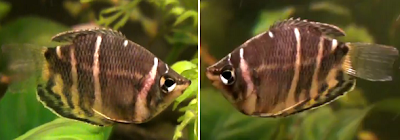
Decorating and preparing the tank for your chocolate gourami to become their home is perhaps the best part about caring for this fish. Since they require soft water, adding bogwood shouldn’t bring any harm to them because the slow release of natural chemical called tannins is actually beneficial for your pet fish. For plants, you have to select the right type of aquatic vegetation which can tolerate soft water, and for this reason, Alternanthera sessilis (Sessile joyweed) and Hygrophila polysperma (Indian water star) will make excellent addition to your aquarium. These plant species provide a lot of benefits, not only as perfect cover during spawning but also it helps to stabilize the water quality absorbing the waste and releasing nutrients to the water. Their presence also helps to contain and control algae growth not to mention helping to achieve crystal clear water. Thus having aquarium plants in the tank will play a major role in your effort not only to decorate but also to create a true living biotope. To promote plant growth, make sure that crypto fertilizers are routinely applied and with that, it also requires constant trimming to maintain the right density of leaves coverage. These together with the bogwood will create a natural look that will definitely be the envy of your friends. For the aquarium bed, you can also consider using gravels but make sure the type that you select is chemically inert or else it will alter the water condition especially the hardness level. For lighting, you can opt for the white fluorescent lamp applied against the dark background to project and bring out the whole aquarium setup into focus. Also don’t forget, since these fish belong to the hot Asian climate region, the water temperature, should also be raised slightly higher in between 28 to 30degC and therefore, if you are living in cold climate countries, having a heater is a must.
How to Breed your Chocolate Gourami
This species of labyrinth fish is a typical example of a mouth brooder which means that they protect their fertilized eggs and newly hatched young larvae in the mouth. In order to successfully breed your pets, you will need a group of at least 4 -5 healthy adults in order to ensure that you have at least one mating male and female pair. The male can be identified by its pointed-shaped dorsal fin which is thinner while for the female fish; the overall fin shape is generally rounder. Also for the females, you can also find that the area close to the belly region is slightly plump due to the presence of eggs. These observations should be easy for those experienced fish keeper but somehow, most hobbyist especially beginners may find it hard to spot the sexual differentiation. Furthermore, not all adult chocolate gourami will become active breeding pair, so this is also something which you need to take into consideration. Thus this reaffirms the statement mentioned earlier which suggest the aquarist to acquire more young fish and raise them together, so that there's higher chance to ensure that the breeding program is successful.
The courtship behavior is a very interesting affair to watch as the male will begin by spreading its fins and its whole body will then quiver inside the loop formed by the female’s curving body shape. After a short while, the eggs will be released usually about 50 – 80 (depending on the size and age of the female fish) and then for the next few minutes both parents will stay close to each other before the mother starts to gather up the eggs into her mouth. She will then isolate herself going into hiding amongst the plants and only after about 3 weeks later, you can see the free-swimming fry being released by the mother so that they can explore their surrounding environment. A young chocolate gourami looks almost identical compared to the adult fish except for the smaller size. Once you can see them coming out from their hiding spot, you should start looking into the option to provide continuous supply of fresh live foods such as microworms plus brine shrimps so that they have nutritious meal and the resulting effect is that this helps them to grow faster. A full-grown specimen captive-raised in home fish tank usually reaches a total length of 2 inches (about 5cm).
Another closely-related gourami labyrinth fish: Honey Sunset Gourami
Other related subject: How to breed Betta Fighting Fish
How to Breed your Chocolate Gourami
This species of labyrinth fish is a typical example of a mouth brooder which means that they protect their fertilized eggs and newly hatched young larvae in the mouth. In order to successfully breed your pets, you will need a group of at least 4 -5 healthy adults in order to ensure that you have at least one mating male and female pair. The male can be identified by its pointed-shaped dorsal fin which is thinner while for the female fish; the overall fin shape is generally rounder. Also for the females, you can also find that the area close to the belly region is slightly plump due to the presence of eggs. These observations should be easy for those experienced fish keeper but somehow, most hobbyist especially beginners may find it hard to spot the sexual differentiation. Furthermore, not all adult chocolate gourami will become active breeding pair, so this is also something which you need to take into consideration. Thus this reaffirms the statement mentioned earlier which suggest the aquarist to acquire more young fish and raise them together, so that there's higher chance to ensure that the breeding program is successful.
The courtship behavior is a very interesting affair to watch as the male will begin by spreading its fins and its whole body will then quiver inside the loop formed by the female’s curving body shape. After a short while, the eggs will be released usually about 50 – 80 (depending on the size and age of the female fish) and then for the next few minutes both parents will stay close to each other before the mother starts to gather up the eggs into her mouth. She will then isolate herself going into hiding amongst the plants and only after about 3 weeks later, you can see the free-swimming fry being released by the mother so that they can explore their surrounding environment. A young chocolate gourami looks almost identical compared to the adult fish except for the smaller size. Once you can see them coming out from their hiding spot, you should start looking into the option to provide continuous supply of fresh live foods such as microworms plus brine shrimps so that they have nutritious meal and the resulting effect is that this helps them to grow faster. A full-grown specimen captive-raised in home fish tank usually reaches a total length of 2 inches (about 5cm).
Another closely-related gourami labyrinth fish: Honey Sunset Gourami
Other related subject: How to breed Betta Fighting Fish